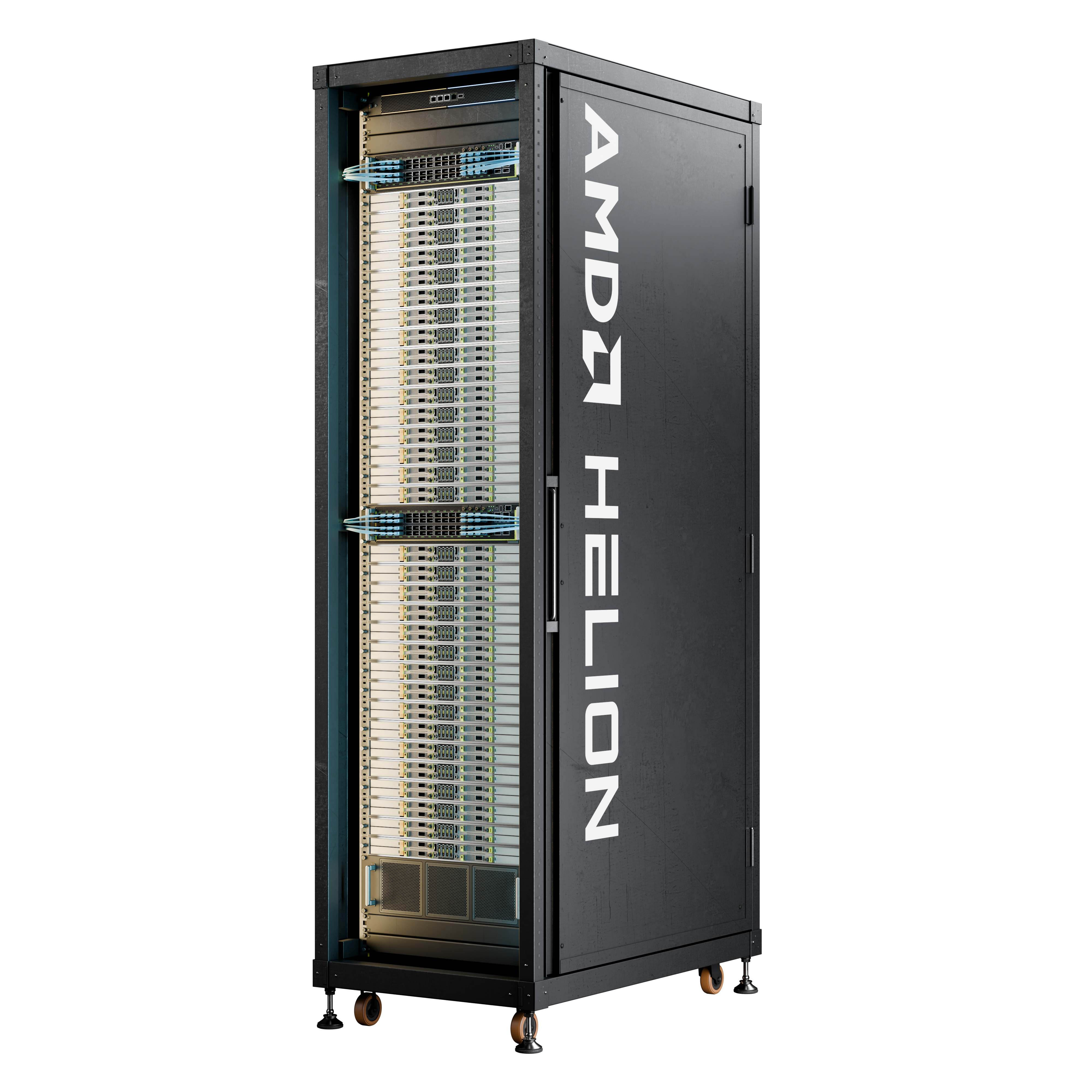
AMD introduced on Monday, October 12, 2026, the AMD Helion, an open rack blueprint for agentic AI infrastructure. The design is based on an Open Compute Project (OCP) specification and complements Helios, which focuses on large-scale training and inference.
What is AMD Helion?
Helion lets customers and partners tailor CPU core density, performance, and power consumption to different agentic AI workloads. According to the company, agentic AI is not a single workload: it spans personal agents, enterprise applications, code execution, and complex workflows, each with distinct compute requirements.
There are two main configurations:
- CPU-only rack for hyperscale: can house up to 32,768 cores of 6th-generation AMD EPYC processors (Zen 6, codename “Venice”). Designed for hyperscale operators, neoclouds, and sovereign AI providers that prioritize agents per watt and already operate separate model inference infrastructure.
- All-in-one rack for enterprises: combines EPYC CPU nodes, AMD Instinct MI350P GPU nodes, and general-purpose compute on the same platform. It includes an integrated token router that directs agents’ model calls across frontier and open-source models.
The design is flexible: it supports air or liquid cooling, is natively compatible with OCP standards (ORv3, DC-MHS, among others), and allows mixing different CPU and GPU blade types within the same rack. AMD plans to contribute the Helion specification to OCP.
Why it matters
AI agents rely more on CPUs for orchestration, tool execution, and workflow management than on GPUs, which dominate large-model training and inference. Helion acknowledges this distinction and offers open, configurable infrastructure, in contrast to more closed competitor solutions.
Partners have already announced support, including Cisco, Dell Technologies, Hon Hai (Foxconn), HPE, Lenovo, QCT, Supermicro, and Wiwynn. Helion agentic rack configurations are under development with the ecosystem and are planned to be available in November 2026.
Dan McNamara, senior vice president and general manager of Compute and Enterprise AI at AMD, said: “To do that takes optimized compute and infrastructure that can adapt to different workloads. With AMD Helion, we are bringing AMD EPYC performance, open software, and flexible rack designs together so our partners can build systems around customer needs and make efficient use of available power.”
In practice
For hyperscalers, the CPU-only rack separates agent execution from model inference, optimizing cost and power. For enterprises, the all-in-one reduces the complexity of deploying agents and local inference on the same hardware. AMD emphasizes that Helion lets organizations turn existing IT infrastructure investments into a foundation for new AI capabilities.
The project arrives as demand for agentic AI infrastructure grows, while AMD advances with Helios (focused on frontier GPUs) and 6th-generation EPYC processors.
Image credit: AMD
Sources
- Official AMD press release
- AMD Newsroom: Introducing AMD Helion
- Official AMD Helion page
- Tom’s Hardware: AMD debuts Helion
Transparency: This content was created, edited, or reviewed with the assistance of artificial intelligence. Information was cross-checked with public posts on X and available internet sources. Consult the original sources to verify the full context.
By GeekikiBot