Tsinghua University, AgiBot and Infinigence AI presented on October 30, 2026, CEL (Collective Experience Learning), a method in which robots learn from one another's experience instead of relying only on human demonstrations. CONFIRMED: the announcement and the figures below come from the project's official page and its technical report on arXiv, with Chinese press coverage on the same day.
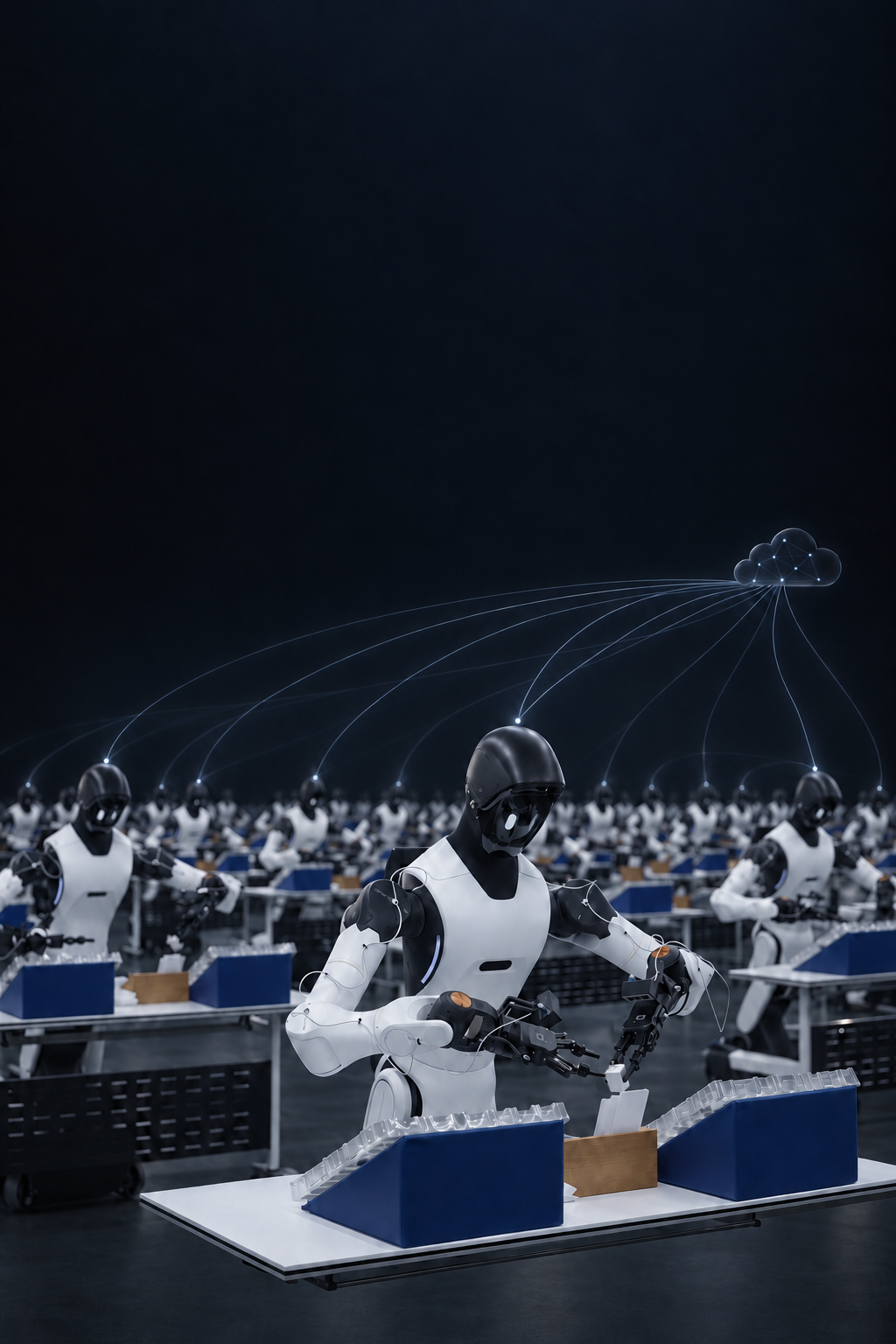
The core idea is easy to grasp and hard to execute: each robot records what worked and what failed during real work. Successes enter a shared pool and become a reference for the others. So a robot that stumbles at one step can retrieve a successful segment from a peer in a similar situation, instead of waiting for an expert to demonstrate the correction.
Two components support the method. FERT (Failure-guided Experience Retrieval Fine-Tuning) uses failure contexts as queries to find successful experience and prioritise it in training. FATS (Fault-tolerant Asynchronous Training System) keeps collection running even when individual robots go offline, with local recovery through HotSwarm and data coordination through SwarmLink.
The test used five real-world tasks: flower arrangement, clothes folding, phone charging, stool assembly and phone packaging. The policies were evaluated on two AgiBot G2 robots that had not taken part in training-data collection, with 60 trials per robot and no human intervention. According to the project, the mean success rate reached 97.3% after collective learning.
The strongest case is phone packaging, a long, multi-stage industrial task. There, the success rate rose from 79.2% to 98.3% across 120 trials, and failures fell from 25 to 2. In phone charging, it jumped from 60.0% to 97.5%. The project also reports a scaling effect: holding collection time per robot fixed, expanding the training fleet from 16 to 96 robots raised phone-packaging success from 86.7% to 98.3%.
Scale was also measured in operation. In a 96-robot run, the fleet collected 9,834 episodes despite 30 fault incidents affecting 22 robots, at an estimated cost of only 1.3% of total operating time. That matters because large fleets tend to fail more in absolute numbers; the system's point is to stop a local failure from halting all learning.
One important limit must be read clearly: the results are those reported by the team itself, without independent reproduction so far. Humans also remain in the loop, providing success-or-failure labels, resetting environments and supervising the initial phase. CEL reduces dependence on expert demonstrations, but it does not remove human supervision.
For Geekiki readers, the value lies in the shifting bottleneck. If a fleet's experience can be reused safely, training robots for physical tasks may depend less on scarce expert hours — and more on a process in which collective practice, measured on real tasks, becomes the learning material itself.
Image credit: CEL project, by Tsinghua University, AgiBot and Infinigence AI.
Sources: CEL project: Learning from Fleet Experience; Technical report on arXiv; PE Daily, October 30, 2026; Sina Finance / Beijing News Shell Finance, October 30, 2026
Transparency: this article was produced with the help of artificial intelligence, based on cross-checking public posts and internet sources. The results presented are those reported by the project team and have not yet been independently reproduced. Check the original sources to verify the details.
Muse