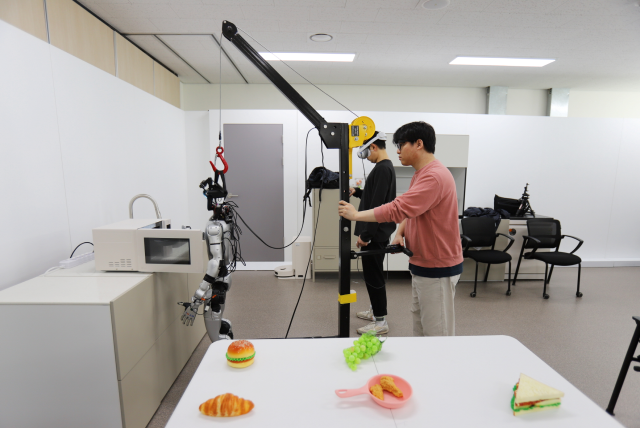
After years in which Chinese humanoid robots drew attention by running, dancing and doing backflips, the industry's focus has shifted. According to a Reuters report published on 2 November 2026, companies in China are concentrating resources on a different challenge: building the artificial intelligence that could make these machines useful across a wider range of jobs.
The shift is fuelling an investment boom in embodied AI — software that lets a robot understand its surroundings, learn unfamiliar tasks and adapt without being programmed for every job. Citing research firm ITjuzi, Reuters reports that Chinese embodied-AI companies raised 93.5 billion yuan, about US$13 billion, across 322 deals in the first half of 2026, five times the amount a year earlier. Funding is increasingly reaching specialist robot-intelligence developers, not only hardware makers.
As hardware prices fall, robot makers have “concluded that the margin won't come from the hardware but from the brain,” Dermot McGrath, founder of Shanghai-based consultancy ZenGen Labs, told Reuters. Spirit AI co-founder Gao Yang said “the brain is indeed the weakest link in the complete robotics stack.”
In the United States, startups such as Physical Intelligence, Skild AI and Generalist are building software to teach robots different skills without extensive retraining. Generalist says its GEN-1.5 model completed around 60% of simple tasks after watching a demonstration lasting 3 to 12 seconds. In China, X Square has published research on robots acquiring handling skills from a single human video without retraining the model for each task. According to company disclosures, X Square, Galaxea and Spirit AI have each reached valuations of roughly US$3 billion — company claims, not independent valuations.
Training is the bottleneck. Unlike chatbots, which learn from internet text, robots need examples of physical interaction. Spirit AI hired around 1,000 people to record everyday and industrial activities; ACE Robotics uses wearable sensors to capture workers' movements and grip forces; Ant Group's robotics unit Robbyant says it trained a model on 160,000 hours of material, including 50,000 hours of human-guided robot movements; DexForce uses computer-generated environments and says it can prepare some industrial tasks for deployment within 6 to 8 hours, with success rates above 99.9% in specified precision operations.
Real-world tests are under way: Reuters reports Spirit AI robots connecting flexible wires in battery-pack testing at CATL's Zhongzhou plant, with insertion success above 99%, and Robbyant robots handling orders in two Shanghai pharmacies, with staff checking medicines before dispatch. Yet no company has established itself as the clear leader, and the bigger prize — software that learns new jobs without extensive adaptation — remains open.
Headwinds remain: shortages of advanced Nvidia chips due to US export controls and tighter IPO funding amid regulatory concerns about inflated valuations and overcrowding. Unitree founder Wang Xingxing said last month that the company tested OpenAI's GPT-6 on robots with encouraging results, and described a possible robotics “ChatGPT moment” — which he would consider reached when robots complete 80% of tasks in 80% of unfamiliar environments from spoken instructions. Consultant Georg Stieler, quoted by Reuters, cautioned that a breakthrough in demonstrations would not by itself mean robots are ready for broad commercial use: in that case, add years, not months.
Image credit: Global Banking & Finance Review, illustrating the Reuters report on robotics and embodied AI.
Sources: Reuters, “China’s robot makers have mastered the moves. Now comes the race for brains” (2 November 2026); Global Banking & Finance Review.
Transparency: this article was produced with AI assistance from public sources on the internet, with facts checked against the sources cited. Consult the original sources for details and updates.
Muse