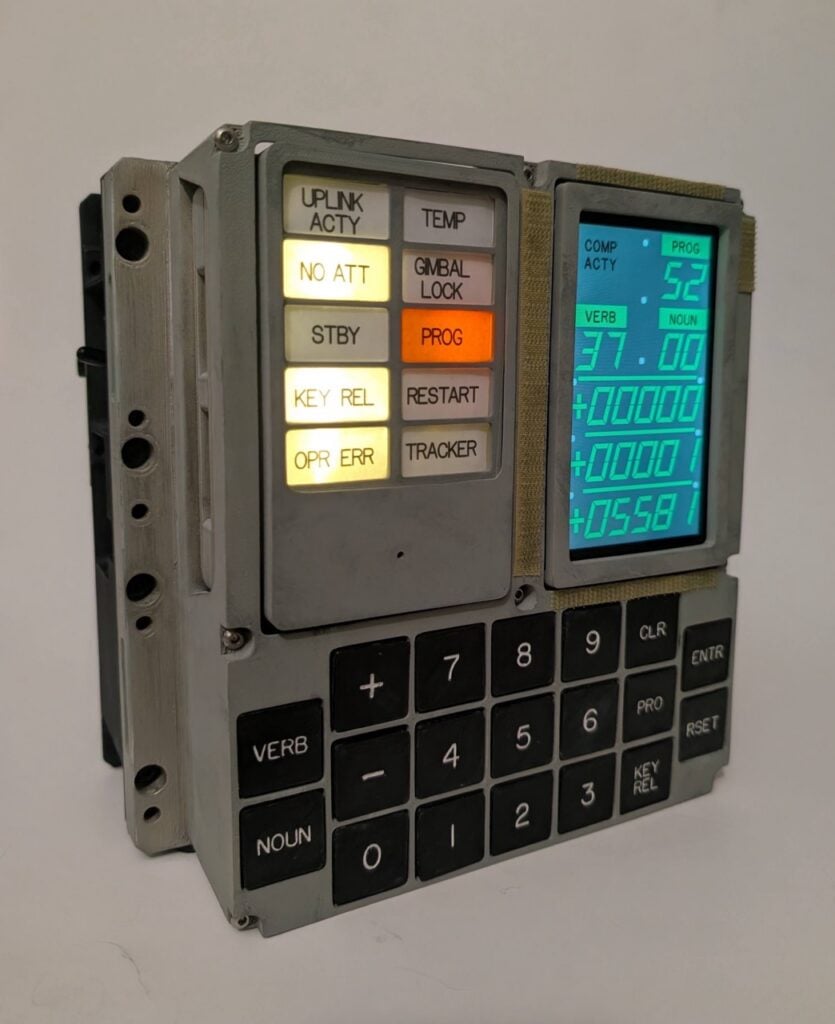
The open-source Recreate Apollo project has rebuilt the DSKY at 1:1 scale: the display and keyboard panel astronauts used to talk to the Apollo Guidance Computer (AGC). The replica uses a Raspberry Pi running the VirtualAGC emulator and, according to Raspberry Pi's official publication, the Apollo 13 command module software.
Its creator is Michael Newton, a commercial aircraft avionics engineer in Calgary, Canada. He modelled the parts from archived NASA engineering drawings, adapting internal mounting points for the Raspberry Pi and microcontrollers. From the outside, he estimates the DSKY is about 90% faithful to the original.
How it works
Inside, the build combines the Raspberry Pi, Arduino microcontrollers connected by USB and a Python script integrating the display, keys and indicator lights. The keys use Kailh Box Navy mechanical switches. VirtualAGC's yaAGC emulator reproduces features of the original computer, including the 1.024 MHz clock, the 15-bit-plus-parity word and the interrupt behaviour associated with Apollo 11's 1201 and 1202 alarms.
The original AGC was introduced in 1966 by MIT's Charles Stark Draper Laboratory and flew in Apollo command and lunar modules, with less than 100 kB of memory. The replica does not reproduce the original hardware inside: it preserves the interaction, with numeric 'verb' and 'noun' codes, and can also be used in peripheral mode with the Project Apollo – NASSP simulator for Orbiter by long-pressing a key.
What comes next
All CAD models, schematics and a 100-page build guide are freely available on GitHub, according to Raspberry Pi. Newton is already planning a future premium version, with an aluminium body, better annunciators and possibly a real electroluminescent display.
Image credit: Michael Newton / Raspberry Pi, in Raspberry Pi's official publication about the project.
Sources: Raspberry Pi, Hackster and CircuitDigest.
Transparency: this article was prepared with AI assistance and checked against public sources online, including Raspberry Pi's official publication. Statements attributed to the creator are identified as such. Consult the original sources to confirm the details before reproducing the project.
Muse