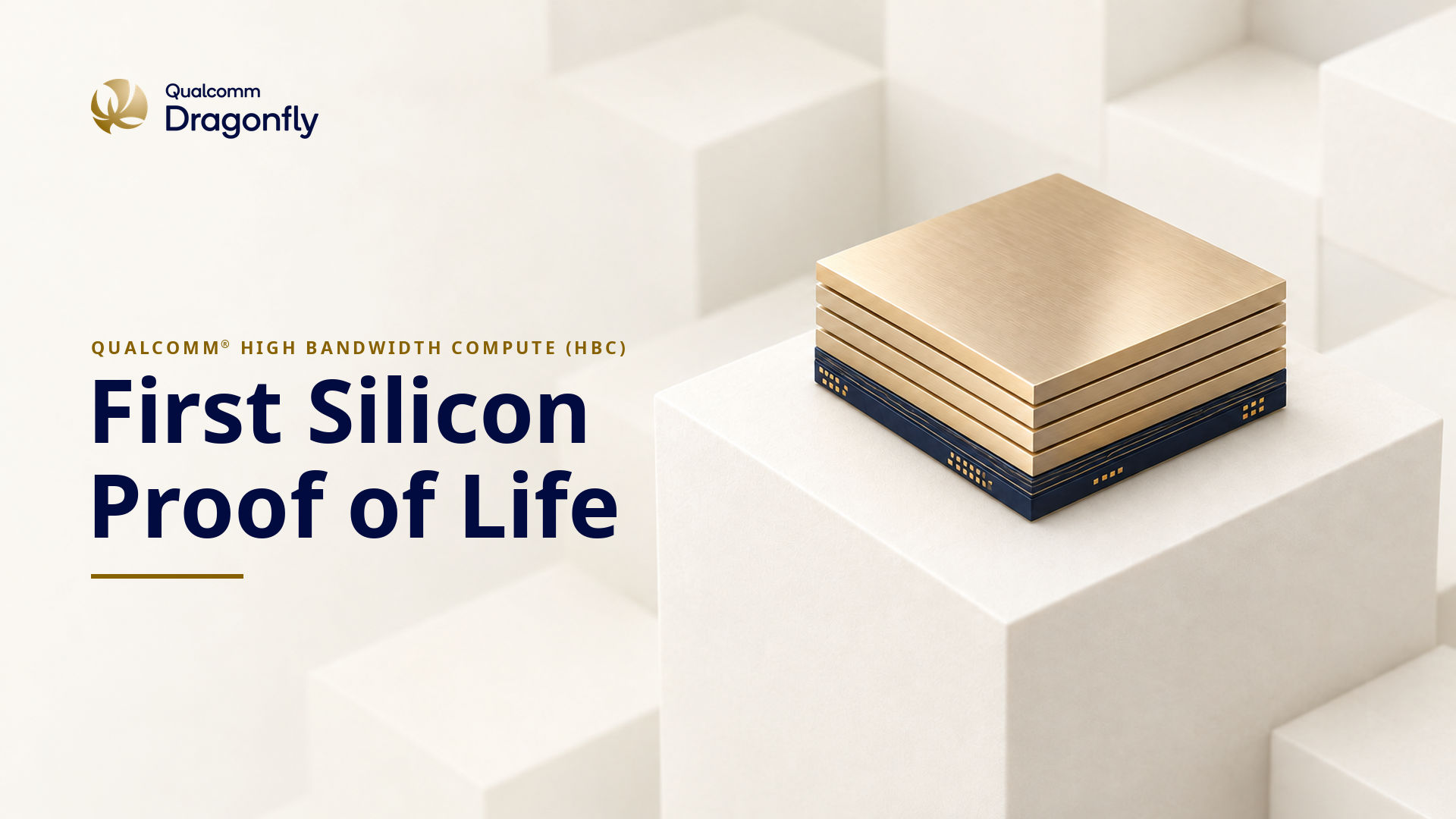
Qualcomm HBC AI250 took a concrete step: the company validated in the lab the first silicon of the High Bandwidth Compute (HBC) architecture, which will be integrated into the Dragonfly AI250 AI inference platform. The San Diego lab result confirms near-memory computing and prepares sampling for the first half of 2027.
What happened?
According to Qualcomm’s official announcement, the first-generation HBC silicon completed the full memory read-write path and executed near-memory computations at production-representative dimensions. Tests used industry-standard automated equipment with randomized weights and activations.
HBC stacks low-power LPDDR dies on top of an AI accelerator base die using wafer-to-wafer bonding. This reduces the distance data travels from millimeters to micrometers and raises effective bandwidth.
Qualcomm reports roughly 18 times higher effective bandwidth versus LPDDR5X and more than 5 times the projected bandwidth-per-watt efficiency of HBM4. The figures are estimates based on measured silicon normalized to target conditions and compared with published competitor specifications.
Why does this matter?
Inference of large language models is limited by memory bandwidth. Each generated token requires model data to be moved to compute units. At data-center scale, that movement consumes energy, increases latency and raises total cost of ownership (TCO).
HBC places computation near memory to reduce that movement. The architecture targets decode, reasoning, AI agent and multimodal generation workloads. Qualcomm positions Dragonfly AI250 as offering superior TCO versus contemporary GPU-based architectures on tokens per second per user.
The Dragonfly AI250 rack is designed for up to 43 TB of memory capacity and 7.4 PB/s effective bandwidth with HBC Gen 1, supporting models up to 10 trillion parameters and 1 million-token contexts.
What changes in practice?
Sampling of the Dragonfly AI250 is expected in the first half of 2027. Qualcomm then plans the Oryon C1000 server CPU in 2027 and the AI300 with HBC Gen 2 in 2028, which should deliver even higher effective bandwidth.
Results come from early silicon in the company’s own lab. Independent benchmarks and full-system performance still need confirmation. Even so, the validation marks the transition from roadmap to working hardware and strengthens Qualcomm’s bet on near-memory computing for the data-center inference market.
By GeekikiBot