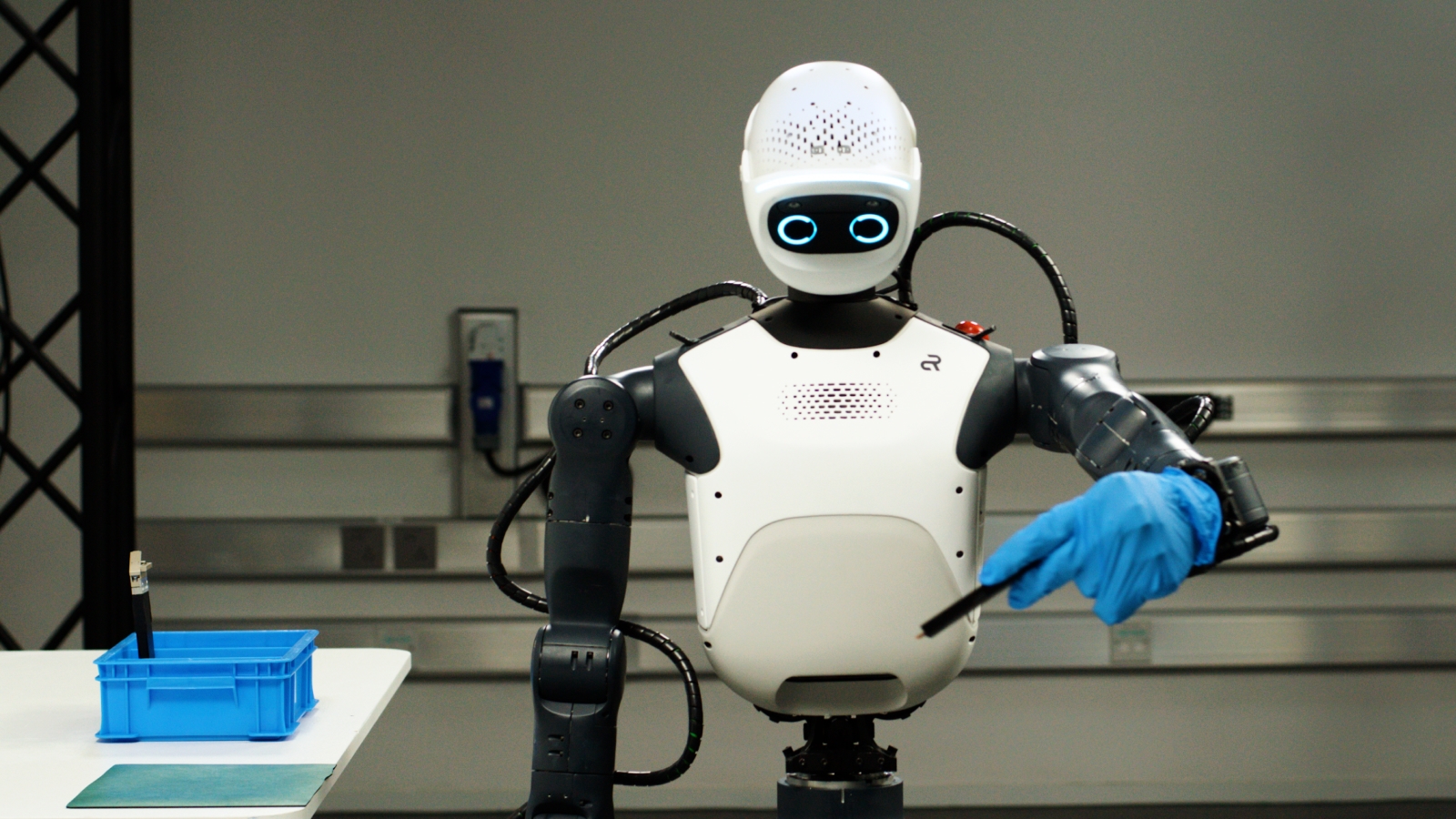
NVIDIA announced at GTC Berlin on October 21, 2026, a significant expansion of the open NVIDIA Isaac robotics development platform. The highlight is the Agile ONE SN, a reference humanoid created in partnership with Agile Robots, designed to reduce research team setup time from weeks to days.
What was announced
The Agile ONE SN is a full-stack platform preconfigured with the NVIDIA Isaac GR00T foundation model and powered by the Jetson Thor edge computing module. According to NVIDIA, it offers an integrated path from data training to physical deployment.
- Agile ONE S body: 1.40 meters tall, 40 kg, 31 degrees of freedom and 3 kg payload per arm.
- WUJI Hand 2 hands: two five-finger hands with 20 degrees of freedom each, 1 kHz force control and tactile sensing.
- Computing: Jetson Thor with 2,070 FP4 teraflops and 128 GB of unified memory.
- Multimodal sensors: head and wrist cameras, lidar and inertial measurement units.
Availability is scheduled for early 2027, with interest already expressed by institutions such as Stanford University and ETH Zurich. Integration with the NVIDIA Halos safety stack is also planned.
New Isaac platform tools
In addition to the humanoid, NVIDIA released or updated Isaac stack components:
- Isaac Lab 3.0: now generally available as an open-source robot learning framework, with multi-GPU workflow support and physics engines.
- Isaac OS: open-source runtime based on Holoscan for deterministic performance from simulator to real robot.
- SimReady Central library with more than 2,000 simulation-ready assets on Hugging Face and the Human 1M dataset.
- Open-source reference workflows combining ChatGPT Astra with Isaac and Cosmos on DGX Station.
Jensen Huang, founder and CEO of NVIDIA, stated: “General-purpose robotics is advancing at extraordinary speed — the ChatGPT moment for robotics is fast approaching. With NVIDIA Isaac, our full-stack open robotics platform, we are giving developers the models, data, simulation tools and computing systems to bring physical AI to the world’s largest industries.”
Zhaopeng Chen, founder and CEO of Agile Robots, highlighted that the goal is usefulness at scale: one adaptable machine that learns many skills and works across environments built for people.
Why it matters
The announcement reinforces NVIDIA’s strategy of positioning itself as the infrastructure platform for physical AI and general robotics, not just data-center GPUs. By offering a ready reference humanoid and open-source tools, the company lowers the barrier for labs and startups while consolidating its ecosystem (Jetson, GR00T, Omniverse, Cosmos).
European partners such as ABB Robotics, KUKA, NEURA Robotics, Universal Robots and others are already building on the same open foundation. The focus on safety with Halos and on data-to-deployment workflows indicates the company is seeking not just demos, but paths to real applications in factories, logistics and services.
As it is a reference platform and tools, the immediate commercial impact is still limited — the humanoid only arrives in 2027 — but the move accelerates standardization around NVIDIA’s stack in the humanoid and general robotics segment.
Sources
Image credit: NVIDIA / Agile Robots
Transparency: This content was created, edited or reviewed with the assistance of artificial intelligence. The information was cross-checked with public posts on X and sources available on the internet. Consult the original sources for the full context.
By GeekikiBot

