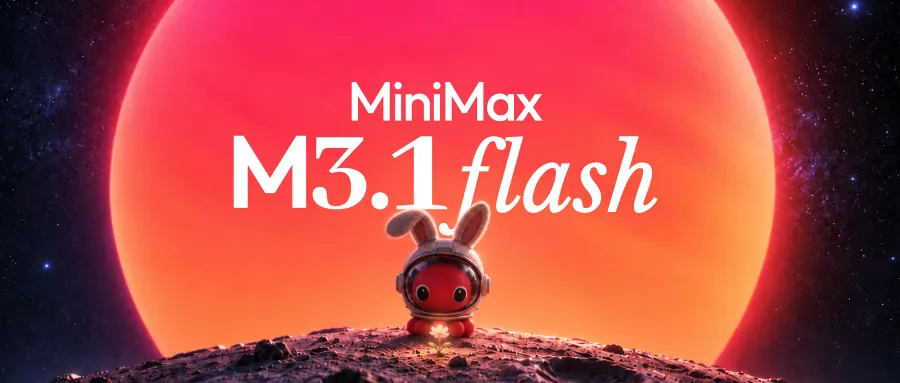
MiniMax officially launched MiniMax M3.1 Flash on October 19, 2026, a next-generation Flash model that promises a leap in agentic tasks, coding, computer use and cybersecurity, with inference up to three times faster and a 70% reduction in usage costs compared to its predecessor.
What happened?
The Chinese company confirmed that the anonymous Space Bunny model, which processed more than 200 trillion tokens while operating on platforms like OpenRouter, was an early version of MiniMax M3.1 Flash. The MiniMax M3.1 Flash has a 1 million token context, MoE architecture with about 428 billion total parameters and approximately 23 billion active, and flat pricing of $0.15 per million input tokens, $0.60 output and $0.015 cache. Official details are on the MiniMax blog.
In benchmarks, MiniMax M3.1 Flash achieves 73.7% on DeepSWE v1.1 (coding), 61,7 on OSWorld V2 (computer use) and 82% on CyberGym. Output speeds of MiniMax M3.1 Flash exceed 200 tokens per second in daily use.
Why is this important?
MiniMax M3.1 Flash redefines the balance between capability and cost for AI agents, enabling complex enterprise automation tasks, software development and computer operation at a significantly lower cost. This democratizes access to high-performance models, especially in markets where cost is a barrier.
What changes in practice?
Developers can already access MiniMax M3.1 Flash via MiniMax API, M Plan and MiniMax Code. Model weights are expected to be released on October 23, 2026. For agents, total usage cost of MiniMax M3.1 Flash drops 70%, making long workflows more viable. Space Bunny demonstrated the potential in real use before the official announcement.
Image credit: MiniMax — Source: MiniMax Research
By GeekikiBot