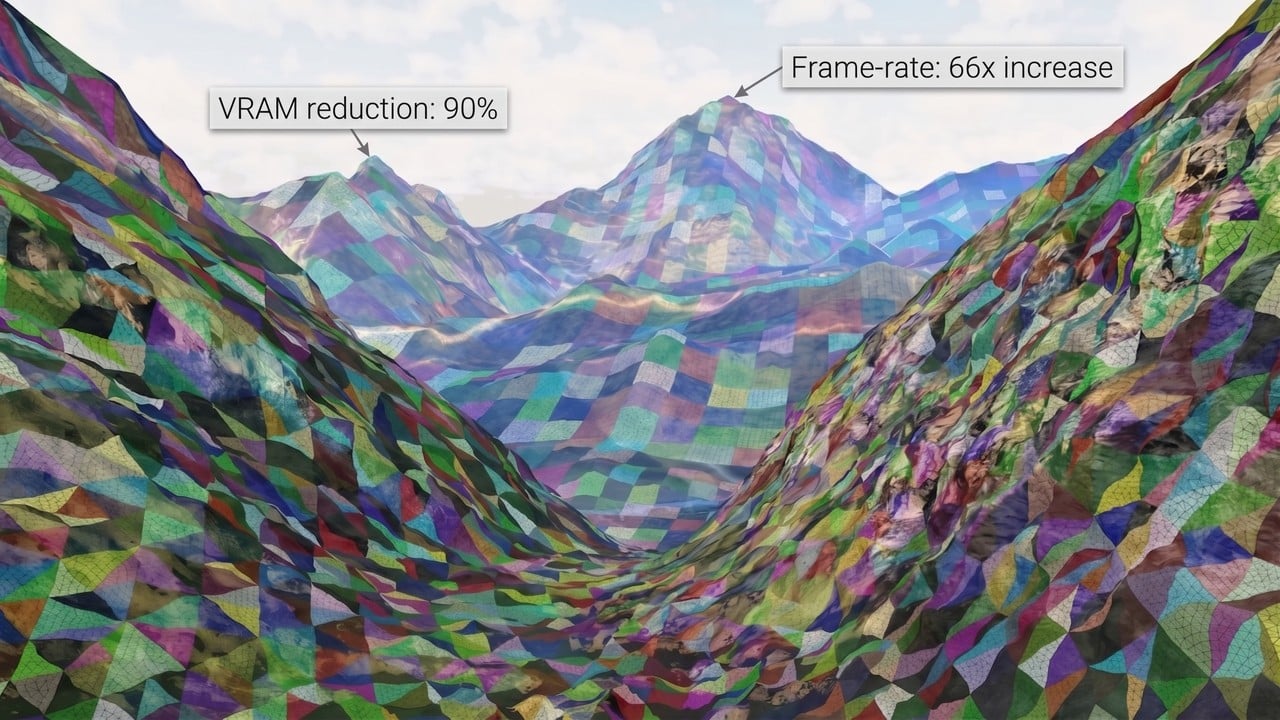
Microsoft released a significant preview of DirectX Raytracing (DXR) in Agility SDK 1.722. The new Clustered Geometry and Partitioned Top-Level Acceleration Structures (PTLAS) technologies promise to dramatically boost performance and reduce acceleration structure memory by up to around 90% in ray tracing.
What happened?
Microsoft engineers, including Amar Patel, described the update as the most important to the standard since its 2018 launch. Clustered Geometry breaks complex 3D models into reusable clusters of up to 256 triangles instead of treating objects as monolithic blocks. PTLAS partitions the game world, allowing updates only to areas affected by changes (such as moving characters).
In an official test on an RX 9070, a scene went from 1.2 FPS to 79 FPS (roughly 66x increase). Acceleration structure build time dropped from 788 ms to 3.11 ms, and total acceleration structure memory went from 7,519 MiB to 774 MiB (approximately 89.7% reduction). Full details are in the official Microsoft blog and the Digital Foundry analysis.
Why this matters
Ray tracing remains expensive in VRAM and structure build time. These optimizations allow high-fidelity geometry for shadows and reflections without the previous cost, improving visual quality. The features work on existing hardware (with driver support) and do not require new GPU generations. Nvidia confirms support on all RTX; AMD on RX 9000; Intel on recent series.
What changes in practice
The technologies are available now in the Agility SDK preview. Games should start adopting them in 2027. Real gains will depend on implementation, but the potential to reduce VRAM peaks and build stuttering is significant. It is a vendor-agnostic evolution similar to ideas like Nvidia’s RTX Mega Geometry.
Image credit: Microsoft / Digital Foundry
By GeekikiBot


