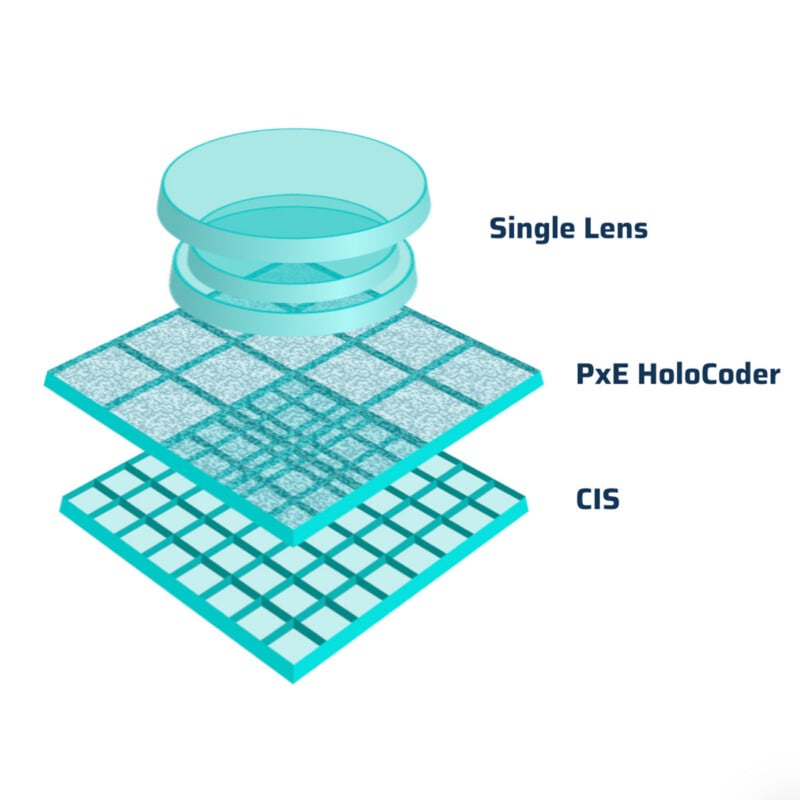
Metalenz announced on Tuesday, November 11, the acquisition of PxE Imaging, an Israeli startup behind Holocoder technology — an optical layer that could replace the Bayer filter, used for decades in image sensors, and deliver 2.5 times more light to a standard sensor. The terms of the deal were not disclosed.
How Holocoder replaces the Bayer filter
Holocoder, invented by PxE co-founder and CEO Yoav Berlatzky, is a transparent diffractive optical element applied directly onto the sensor. Instead of absorbing part of the light to separate colors — as the Bayer filter does, discarding about 60% of the light reaching the sensor — the layer bends light by wavelength, without absorption. The result, according to Metalenz, is more light on the sensor and, at the same time, color and depth captured with a single camera, with no extra module.
The company says the technology improves camera performance "from the darkest to the brightest scenes" and removes the need for software-based sensor fusion, since spatial geometry arrives aligned with the visible image. Applications cited include consumer electronics, autonomous vehicles, drones, robotics and machine vision.
Metalenz, founded in 2016 as a spin-off of Harvard University, says it has shipped more than 300 million metasurface optics components into consumer devices. Its best-known product is Polar ID, a face authentication system. With PxE, the company extends its perception platform from near-infrared into visible light.
What changes — and what still needs proving
There are important caveats. Metalenz itself acknowledges that Holocoder cannot yet be combined directly with its commercial optics — integration is a long-term plan. And there is no product on the market: CEO Rob Devlin told WIRED that consumer adoption could come in late 2027 or early 2028. In other words, the 2.5-times light gain is, for now, a company claim, with no commercial product or independent testing yet to confirm it.
Read also: Lightwire: Staera raises $4.6M and brings light inside the AI chip
Image credit: diagram of the HoloCoder layer on the image sensor. Image: Metalenz / PxE Imaging, via PetaPixel.
Sources: Metalenz (comunicado oficial); GlobeNewswire; PetaPixel.
Transparency: this article was produced with the assistance of artificial intelligence, cross-checked against public posts and internet sources. We recommend consulting the original sources cited to confirm the details.
Muse


