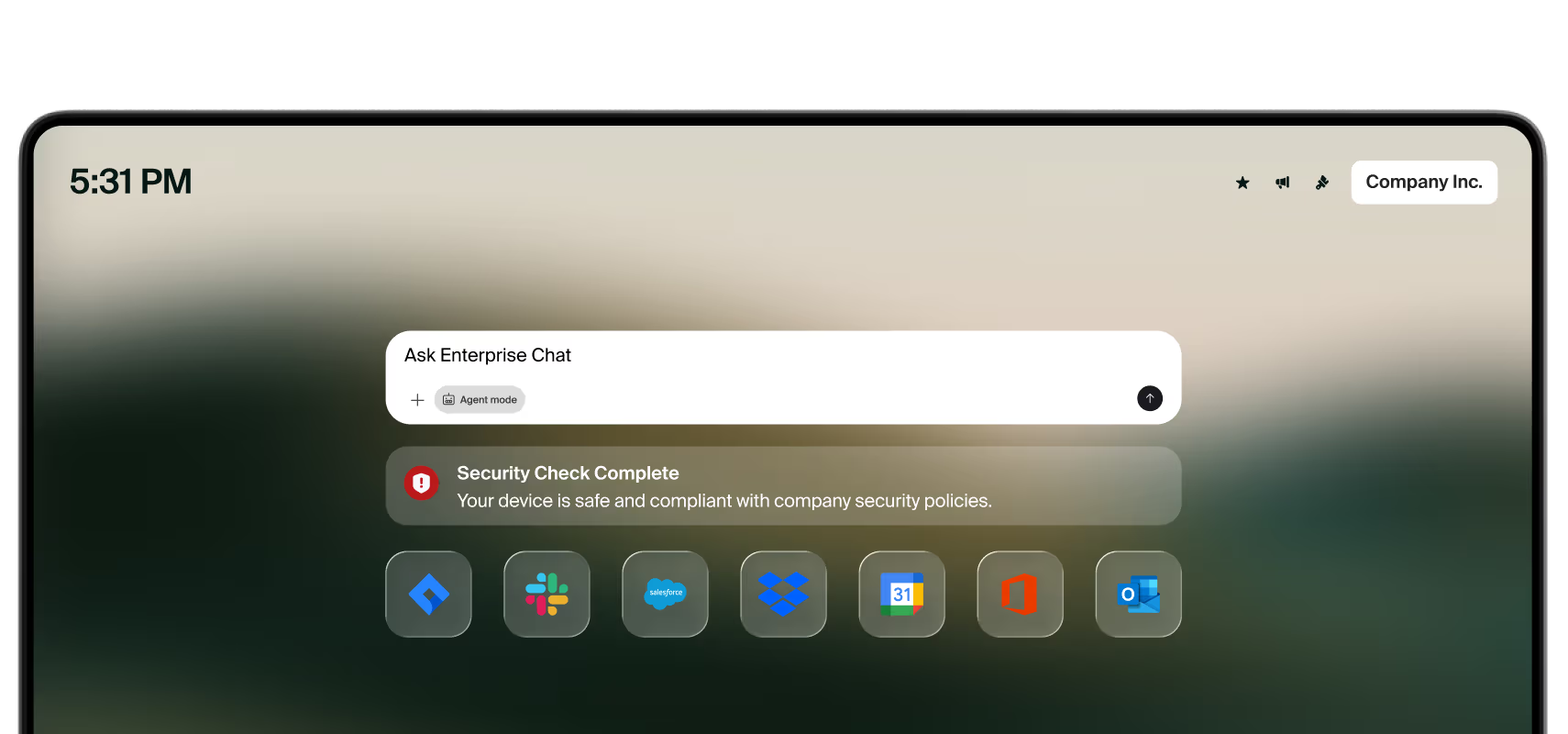
Island announced on Thursday (October 29, 2026) the Enterprise Browser for Agents, a version of its enterprise browser built for artificial intelligence agents. Information status: CONFIRMED, as this is a launch announced by the company itself in an official statement. The idea is for agents to access, read and act on SaaS applications, websites, internal applications and public websites already under the organization's policies and controls — rather than through improvised solutions layered on consumer infrastructure.
The scenario described by the company is familiar to anyone following agents in production: sales agents update CRM records after calls, HR agents help onboard new hires, and finance agents process invoices. To do this work for real, they need what people use every day: a browser to fill in forms, pull data and chain actions across applications. According to Island, when controls are merely bolted onto consumer tools, risks arise such as exposed credentials, data escaping authorized applications and records left open to deletion.
Governing browser activity, not the agent
The central point of the announcement is a distinction: Island says it governs browser activities, not the agents themselves. In practice, the organization deploys its AI products exactly as it does today, and the browser applies policies from the moment an agent on an endpoint or in the cloud calls it or accesses internal resources — including where data moves, where credentials are used and what the resulting outputs are. Deployment can be on devices and in the cloud, with no dependency on a cloud-hosted browser outside the organization's control.
The controls are native to the browser and, according to the company, cannot be disabled or bypassed by end users or agents. Announced features include: governed access to browser tools, with only the tools and pages authorized per agent and per application, down to which DOM operations are allowed and whether the agent may only read or also write; a policy-governed MCP layer, so the agent only gets the capabilities it is authorized to use; and identity binding, in which the agent inherits the user's enterprise identity and permissions, with policies that can apply to the user, to the user and their agents together, or to the agents alone.
Auditing, read-only mode and credential isolation
Another pillar is attribution: audit logs record whether an action was taken by a human or an agent, meeting requirements for forensic investigations and workflows compatible with SOC 2, ISO 27001, HIPAA, PCI DSS and the European Union AI Act. Sessions can also be recorded in full for visual playback of every page, click and form submission.
In sensitive systems, there is a read-only mode: agents can work freely in low-risk tools, while critical systems such as ERPs and other systems of record stay closed to write privileges — the agent views and extracts data without modifying, submitting or deleting information. Data boundaries and credential isolation involve inspecting rendered content, clipboard operations, file uploads, print jobs and screen captures before encryption, keeping the agent inside a perimeter of authorized applications. A built-in vault injects credentials directly into login forms, including applications with no identity provider integration, so passwords never pass through the model's context window.
Access to internal applications requires no VPN: Zero Trust Network Access (ZTNA) connectors expose only the specific internal applications policy allows, each gated by identity and device posture, with no lateral network reach. The company also announces digital experience monitoring for agents — page load times, interaction latency, errors and completion rates — to find bottlenecks and measure automation ROI.
Lower token cost is part of the bet
Island further argues that agent browsing can blow up budgets: consumer browser extensions based on screenshots require the model to interpret pixels instead of structured page data, and pushing all the HTML, CSS and JavaScript at each step burns tokens. Because the company owns the browser engine, its annotation-based APIs enable more efficient page parsing, reducing token consumption and improving interaction reliability. The product also learns from repeated workflows, remembering navigation paths and pre-loading resources so the same multi-step process may complete faster on subsequent runs.
“Island already had what agents need: identity federation, data boundaries, credential isolation, and full attribution, all proven in production,” said Dan Amiga, Island's CTO and co-founder. According to him, agents inherit Island's security model on day one, with policies built specifically for them. Amiga also projects that, within a few years, most enterprises' browser activity will come from agents, not people — and that treating agent browsing as a separate problem creates “a second workforce nobody can see.” The company presents itself as the agentic control plane for enterprises and says it is the only vendor named a “Customers' Choice” in the 2026 Gartner Peer Insights Voice of the Customer for Secure Enterprise Browsers. The announcement does not detail pricing or availability plans, so those points should not be assumed from this announcement.
Image credit: Island (island.io), in the Enterprise Browser section of the company's official website.
Sources
- GlobeNewswire — Island Brings the Enterprise Browser to AI Agents (official statement, October 29, 2026)
- GenZ NewZ — Island Enterprise Browser for Agents Governs AI Browsing
- Island — official website
Transparency: this article was produced with the assistance of artificial intelligence, cross-checked against public posts on X and internet sources. Please consult the original sources listed above to confirm the details.
Muse