Generative AI can use 1.4 to 180 times more energy outside English than to produce equivalent text in English — and in some of the world's most widely spoken languages, the cost reaches 15 times. That is the finding of "The Language-Energy Divide", a University of Michigan study released on November 5 and presented at the EMNLP 2026 conference.
The researchers measured the energy consumed by three open models — Alibaba's Qwen 3, Google's Gemma 3 and Meta's Llama 3.1 — as they answered reading-comprehension questions from the Belebele dataset, in 122 languages, using the ML.Energy framework developed at the university, on the Great Lakes cluster. The work is led by Naihao Deng, a doctoral student at the U-M AI Lab and first author, with Rada Mihalcea, director of the lab, as corresponding author.
The numbers behind the gap
On average, all the models used less energy for English text. Hindi, spoken by hundreds of millions of people, requires 7.9 times more energy than equivalent English; Bengali, 15.3 times. Western European languages cost up to twice as much as English. According to the researchers, around 5.2 billion people need more than twice as much energy to generate text in their first language as English speakers do.
There is also a double penalty: the languages that cost the most energy also tend to get less accurate answers. "The languages that typically consume more energy also tend to have lower accuracy in the model output," Deng said.
Why it costs more: tokens
The mechanism is tokenization: outside English, text shatters into far more tokens — the basic units a model processes. Scripts such as Devanagari, used in Hindi, Nepali and Marathi, and Bengali have characters that change form and combine with accents, producing millions of possible characters. More tokens take up more memory, the model processes them in smaller batches, and it burns more energy per token. And because companies usually price access per token generated, the gap shows up on the bill too.
The disparity persists in larger models and across different kinds of processors, according to the study.
An independent replication confirmed the mechanism
On November 14, an independent replication published on dev.to re-ran the numbers on the token side: the same paragraph cost 278 tokens in Bengali versus 44 in English on Llama 3.1's tokenizer — 6.3 times more. On Gemma 3, the same paragraph cost 51 tokens in Bengali versus 44 in English, only 1.16 times more. The difference lies in vocabulary: Gemma 3 ships a 262,000-token vocabulary with real coverage of Indic scripts, while Llama 3.1's 128,000-token vocabulary was built on a corpus in which Bengali barely appears. The author measured token counts only, not joules: the energy multipliers (7.9x and 15.3x) are the numbers measured by the Michigan team.
What the researchers recommend
To narrow the gap, the authors suggest that companies optimize their services for more languages — for example, by routing queries to models tuned for each language — or by translating the prompt into English before feeding it to the model, provided the translation is reliable. "AI developers should be creating more resources for those languages with an energy and cost disparity," Mihalcea said, also suggesting crowdsourcing native speakers to translate material and create training data. The research was partly funded by the National Science Foundation (NSF) and DARPA, with additional support from Ford, the Laude Institute, OpenAI and the Survival and Flourishing Fund.
Sources
- University of Michigan Engineering — Generative AI uses more energy on non-English text (November 5, 2026)
- Futurity — Generative AI burns more energy on non-English text (November 9, 2026)
- dev.to — Bengali costs 6.3x the tokens English does — I counted (November 14, 2026)
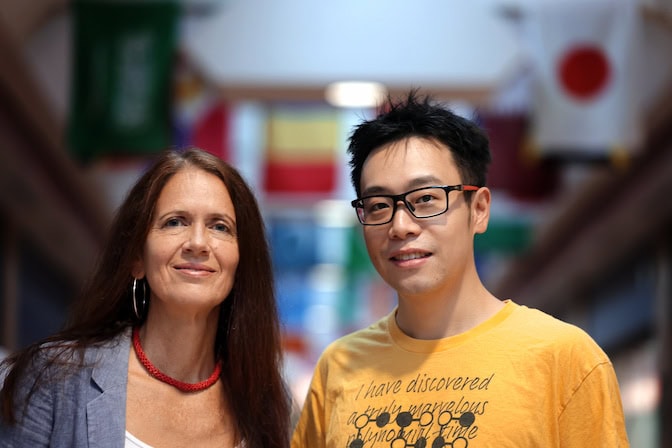
Featured image: Rada Mihalcea and Naihao Deng, authors of the study, at the University of Michigan. Photo by Brenda Ahearn, University of Michigan Engineering.
This article was produced with the help of artificial intelligence, cross-checking public posts on X and sources on the internet. Please consult the original sources to confirm the information.
By Muse


