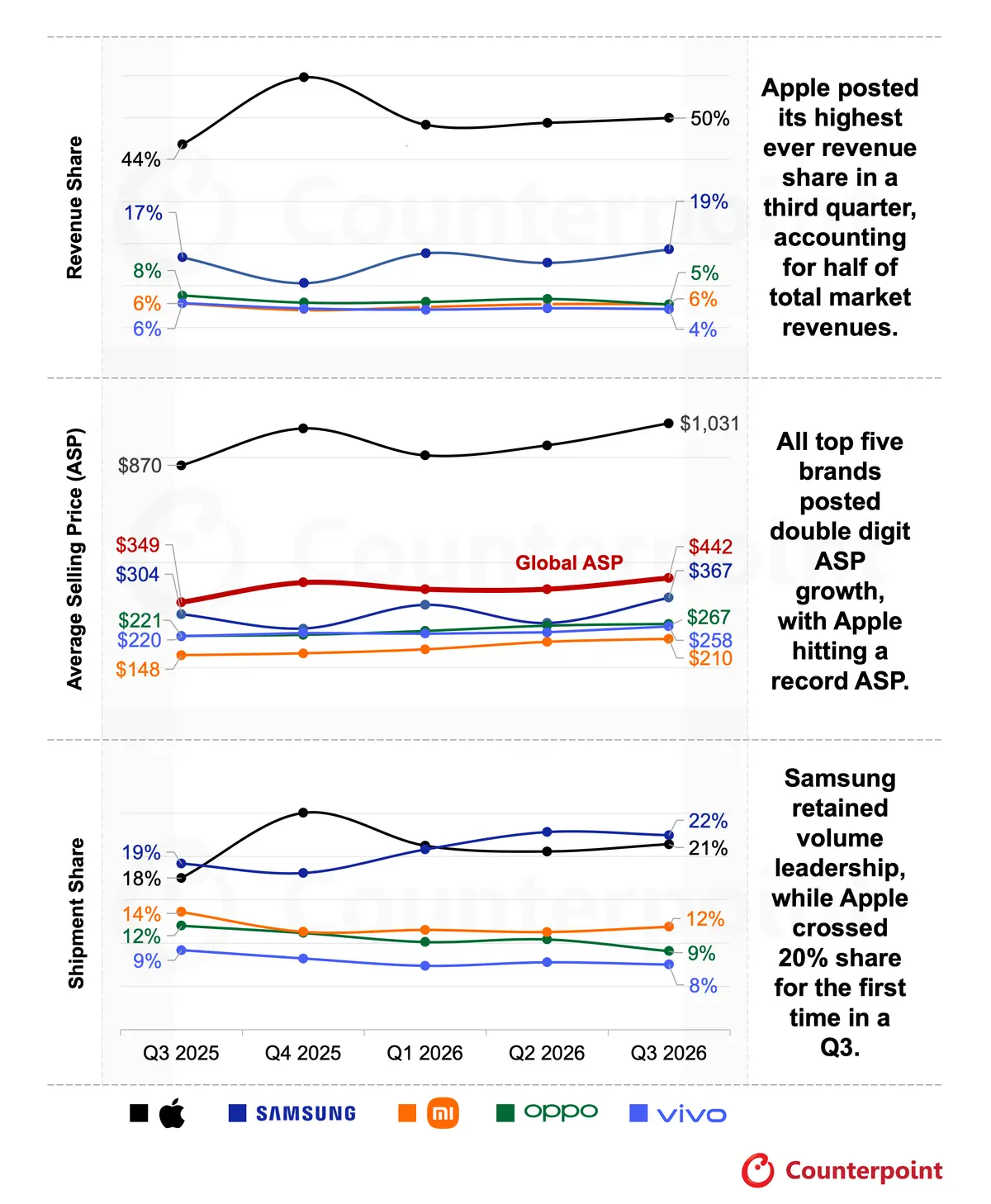
Apple captured 50% of all global smartphone revenue in the third quarter of 2026, a historic record, according to preliminary data from Counterpoint Research published on November 3. In the same period, total industry revenue grew 3% year on year to $114 billion, even as shipments fell 19%. The paradox has a simple explanation: phones got much more expensive.
The global average selling price (ASP) rose 27% in a year to $442, the highest level Counterpoint has ever recorded in a quarter. The increase was driven by a larger share of premium devices and by price increases caused by memory costs across nearly every segment.
Apple and the 50% record
Apple posted its highest-ever revenue for a third calendar quarter, up 17% year on year, and took half of all the money generated by the smartphone market in the period. Its average selling price also rose 19% over the year, while shipments stayed nearly flat. In the previous quarter, the company's revenue share was already 49%.
According to Counterpoint, the performance was supported by sustained demand for the iPhone 17 line and by the arrival of the iPhone 18 Pro, which launched at higher prices without the base iPhone 18 alongside it, plus price increases on older models in September. Apple's average selling price reached $1,031, higher than the combined average prices of all other major brands.
"Apple remained the most resilient major brand in Q3 2026, with shipments nearly flat YoY," said Tarun Pathak, research director at Counterpoint. Geekiki had already reported the iPhone 18 Pro's strong start, growing 3.1% worldwide in its first three weeks, driven by China.
Samsung leads in volume
Samsung ranked second in revenue, with a 19% share and 14% growth year on year, while keeping the lead in shipments with 22% of the total. The South Korean maker's average selling price rose 21% over the year to $367, up from $304 in the third quarter of 2025, driven by price increases in the Galaxy A line and by the contribution of the Galaxy S26 Ultra and the Galaxy Z Fold8, which saw strong early demand.
Xiaomi, OPPO and vivo
Xiaomi kept revenue flat year on year, but with double-digit growth in average selling price, reflecting a portfolio shift toward mid-range and upper tiers, with the Redmi Note 15 and Xiaomi 17T among its top revenue drivers. OPPO and vivo, meanwhile, saw revenue fall 26% and 22% respectively: the drop in shipments outweighed gains from higher prices.
What comes next
The revenue resilience is unlikely to last. Counterpoint expects that in the fourth quarter of 2026, shipment declines will outpace price growth and push global revenue into contraction. For 2027, high memory costs should keep pressuring margins and pushing prices up, with shipments falling again, though more slowly than in 2026. Cost relief is only expected in 2028.
"The smartphone market is increasingly facing a trade-off between volumes and value," said Shilpi Jain, senior analyst at Counterpoint. According to her, the entry-level segment is the most vulnerable, as there is little room to absorb higher costs without hurting margins.
How to read the numbers
The data are preliminary, from Counterpoint's Market Monitor service, and the average selling price is measured on wholesale prices, not on what shoppers pay in stores. Even so, the picture is clear: fewer phones sold, more expensive phones, and an unprecedented concentration of revenue in Apple's hands.
Sources: Counterpoint Research — Global Smartphone Revenue Defies Shipment Slump, Rising 3% YoY; SamMobile — Samsung's smartphone revenue rises 14% as it tops global shipments; Phandroid — Apple Now Collects Half of All Smartphone Revenue Worldwide; AndroidPure — Smartphone Selling Prices Hit a Record $442 in Q3, Counterpoint Says. See also our earlier Geekiki story: iPhone 18 Pro grows 3.1% worldwide in its first three weeks, driven by China, Counterpoint says.
Image: chart by Counterpoint Research (Market Monitor Service, preliminary Q3 2026 data), reproduced from Counterpoint Research's original publication.
This article was produced with the assistance of artificial intelligence, drawing on public posts on X and sources from the internet, including Counterpoint Research's original report and independent coverage from other outlets. We recommend consulting the original sources listed below for further details.
Muse